


Tempest 3
€679.90*
- 3 persons
- 46 × 18 cm
- 2.900 g
The 'Tempest' is available in three sizes, as a 2, 3 or 4-person tent, in the light weight Zero-G line. It is an asymmetrical tunnel tent with three colour coded main frames. Due to the unique cut of the inner tent, it also offers a comfortable sleeping place for large people. It has a rain-protected inner tent entrance and a ...
Product available
This product is available and will be delivered within approximately 3-10 days.
Product number:
231052
Accessory products

Groundsheet Tempest 3
Our Wechsel Groundsheets gives your tent extra protection from wet grounds, thorns, sharp rocks and moisture. They cover the entire base of your tent. They are attached to the tent with elastic loops. The Groundsheet is made of a robust 75D polyester with a PU coating on the inside (7000mm water column)
€73.90*
%

Guy Line Flags (6pc)
These practical flags are the perfect addition to tents, tarps, or wings with guy lines. Their bright yellow color makes the lines much more visible, helping to prevent tripping hazards and potential damage to your tent. In addition to their safety function, the flags offer a clever way to manage excess cord: simply wind up unused guy lines and secure them inside the flag – for better organization and less tangling when packing.
€1.90*
€7.90*
Information "Tempest 3"
The 'Tempest' is available in three sizes, as a 2, 3 or 4-person tent, in the light weight Zero-G line. It is an asymmetrical tunnel tent with three colour coded main frames. Due to the unique cut of the inner tent, it also offers a comfortable sleeping place for large people. It has a rain-protected inner tent entrance and a large vestibule with two entrances. By "unclipping" the front tip of the inner tent, the space in the vestibule can be enlarged. Simply push the unhooked inner tent to the rear. In this way, there is more room, for example for cooking. The front door of the fly sheet can be rolled up completely. That allow a very nice panorama view and easy handling with your gear. All sorts of small stuff can be organized in several mesh pockets in the inner tent
Safety Instructions
Allow the tent and groundsheet to air dry completely before storing to prevent odors and mildew from forming. Always push the pole segments in as far as they will go to prevent damage to the poles. Please note that the packaging is not a toy and does not belong in the hands of babies and small children.
User Manuals
| Color: | Artichoke Green |
|---|---|
| Construction type: | Tunnel |
| Entrances: | 2 entrances |
| PFC free: | yes |
| PVC free: | yes |
| Packing size: | 46 × 18 cm |
| Persons: | 3 persons |
| Pole Diameter: | 9.2 mm |
| Setup: | Fly First |
| Special feature: | Packing Bag |
| Trail weight: | 2.534 g |
| Weight: | 2,90 kg |
Product highlights
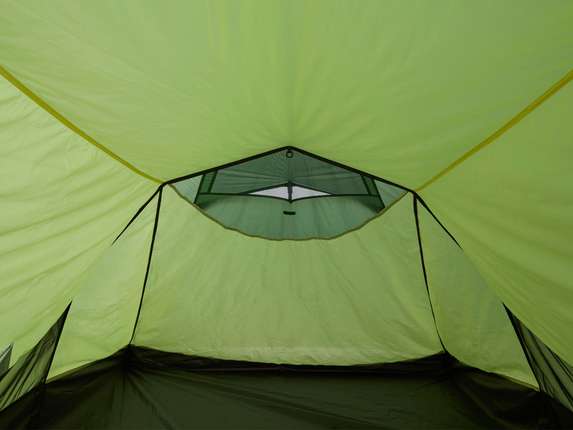
Inner tent
The inner tent is made from a breathable and water-repellent fabric. Mosquito nets are located by the vents and in the upper half of the doors. This means that drops of condensation do not penetrate the inside, but roll off the outside. In addition, there is no unpleasant draught in the tent.
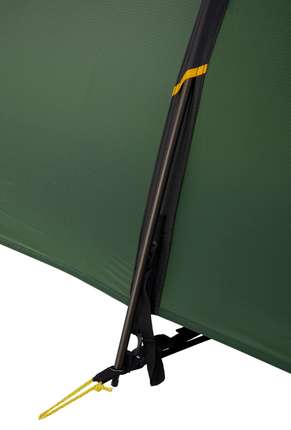
Color-coded poles
The pole end tips and the corresponding pole sleeves are color-coded. This makes pitching the tent quick and easy.
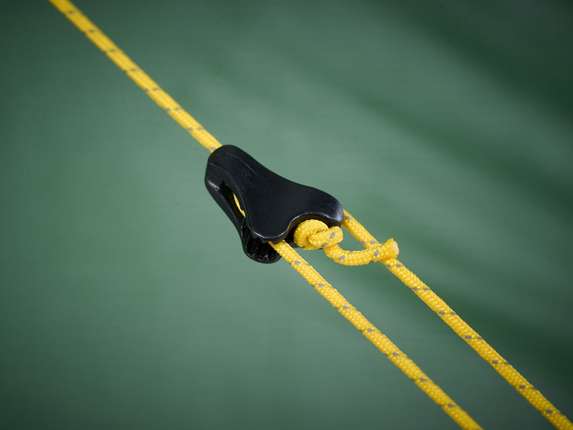
Dyneema guy lines
The guy lines are made of high tensile Dyneema. Woven-in reflective threads make the guy lines more visible. The linelocks enable simple and secure adjustment.
Zero-G Line
Are you searching for a tent to take on long trips up mountains and along valleys, through wind and rain and snow? Do you have to count every ounce you take with you because you and you alone are doing all the carrying? Do you value excellent craftsmanship, functional details and high standards of comfort? Then look no further than the tents in our Zero-G Line. All the fabrics we use are extremely durable and tear resistant. In addition, all tents have an extra-long sleeping area and versatile opening entrances.
Features
- Increased UV protection due to the siliconized outer side of the fly sheet
- High-quality durable PU coating on the bottom as well as on the inside of the fly sheet
- Factory taped seams on the fly sheet and inner tent floor
- Fly sheet fabric with very high tearing strength of 7 kg
- Reflective Dyneema guy lines
- High quality Dur Aluminium V-Pegs
- YKK zippers specially developed for tents
- Processing of all fabrics with high stitch density
- Free of fire retardants
Technical details
| Flysheet: | Ripstop Nylon 20D,silicone coated, 3.000 mm water column, 7kg tearing strength |
|---|---|
| Inner tent: | Ripstop Nylon 20D, water resistent, breathable |
| Floor: | Ripstop Nylon 30D, PU coated, 5.000 mm w.c., taped seams |
| Poles: | Aluminium DAC Featherlite NSL |
360°
Customer reviews
Login
Frequently asked questions
With the appropriate roof racks, our roof tents can be mounted on almost any car. (Convertibles excluded!) If you are unsure, please contact us by e-mail (info@groenberg.com) with as much of the following information as possible:
1. make, model name
2. year of construction
3. roof load (in the operating instructions)
4. roof rails yes/no?
To prolong the service life of the roof tent, it should be maintained regularly and cleaned when dirty. Firstly, the dried dirt should be carefully brushed off with a soft brush. The mattress cover can be completely removed and washed in the washing machine at 30**°** for easy care. The interior can be carefully vacuumed with a hoover or, better still, a hand hoover. Only then should mild detergent and a soft sponge be used. It is important that the roof tent is dried again before folding it up so that no mould can form. If mould does form, it can be cleaned with a mixture of water and vinegar. For particularly stubborn mould, please use a mould remover.
The roof tent should be stored dry and not closed. There is a risk of mould forming when it is closed. The tent must not be loaded during storage.
The recommended maximum speed of 120 km/h should not be exceeded. Please find out which legal regulations apply in the respective country before setting off.
No. Our roof tents are impregnated at the factory and can be used without pre-treatment. If the impregnation wears off after a few years, an impregnation protection, especially for roof tents, should first be tested on an inconspicuous area.
A few spare parts can be found in our shop.If something should break while travelling, our service team is on hand with advice and spare parts available at short notice.
Our telescopic ladders are 2.3 metres long.An extra long ladder (2.6m) can be ordered additionally.
Children love roof tents. For this reason, our roof tents are also suitable for children.
Both variants have many advantages, but also a few disadvantages.Here is a list of the most important ones:
**Softtop (folding roof tent):**
Advantages: significantly lighter than a hard shell, sleeping area doubles, usually covered entrance, usually cheaper price
Disadvantages: Usually takes longer to set up, not as aerodynamic, more susceptible to wind
**Hardtop (hard shell roof tent)**
Advantages: very quick to set up, more aerodynamic, significantly quieter when travelling, offers storage space for blanket, pillow, sleeping bag etc., more legal parking space options (tent does not protrude over vehicle)
Disadvantages: rather impractical for small cars as the footprint is too large, higher weight
Theft-proof nuts delay or even prevent theft, as the nuts can only be loosened with special tools. Another option is to attach a ring-head nut with a padlock to the screws. A GPS tracker can also be an advantage.
The roof load can be found in the owner's manual or can be obtained from the manufacturer. A distinction must be made between the dynamic and the static roof load.
The accessory articles can be found on the article page of the respective roof tent.
Our standard ladders are 2.3 metres long.For particularly high vehicles, we recommend our 2.6m ladder.
Depending on the model, the side walls may or may not be completely removable. This detailed information can be found in the product description of the roof tent.It can be recognised from the product photos.
Our roof tents do not have a power connection. We recommend using a power bank or a mobile battery.
As a standard, our roof tents are not equipped with built-in lighting. This allows you the flexibility to customize your setup to your specific needs. The Exceptions: Our premium models, Groenberg Alvar and Groenberg Tjelvar, come with an integrated lighting solution already installed for your convenience (dimmable LED light, USB port). Our Recommendation for all other models: To make your roof tent feel personal and cozy, we recommend using outdoor lamps or mobile fairy lights.
All the tools required to attach the roof tent to the roof rack are included.However, a ratchet spanner can make the work much easier.
Our pots and pans are made of cast iron.
Our pots have a small notch for a thermometer.
Cast iron is a material that produces reliable results on all heat sources, even on induction hobs and in any type of oven or grill.
Before using the Askja Pot for the first time, you should clean it thoroughly with soap and a sponge and then leave it to dry.
As soon as the pot is dry, it should be baked.To do this, rub the pot and lid with sunflower oil, rapeseed oil or coconut oil and bake it with the opening facing downwards at 200°C for about an hour until a black patina has formed. A gas grill with a bonnet or an oven is suitable for this. Please note that this produces a lot of smoke!
After slow cooling, the pot is ready for the first meal.
Provided the patina is not damaged, it is only necessary to bake it before using it for the first time.
For an even better patina, the Dutch Oven can also be baked several times.
To burn in, rub the pot and lid with sunflower oil and leave it to burn in with the opening facing downwards at 200°C for about an hour until a black patina has formed. A gas grill with a bonnet or an oven is suitable for this. Please note that this produces a lot of smoke!After slow cooling, the pot is ready for cooking.
Baking creates the patina, a natural non-stick coating, without any chemical additives.
The pot should be cleaned thoroughly with soap and a sponge before it is used for the first time and baked on. After that, no chemical cleaning agents should be used on/in the pot.
After use, you should only clean the pot (free of food residue) with warm water and a wooden or plastic spatula/spoon and then allow it to dry thoroughly. When the pot is dry, it should be wiped out with a little sunflower oil.
After cleaning, the pot should be wiped out with a little sunflower oil and can be stored dry with a double layer of wiping paper between the pot and the lid.
Please make sure that there is no oil in the pot, otherwise it could become rancid and have a negative effect on the flavour the next time you cook.
Larger rust spots occur if the pot has been stored too damp or the patina has been damaged.The rust spots can usually be easily removed with a steel sponge, warm water and a little soap. However, the pot must then be baked again.
Sunflower oil, rapeseed oil or coconut oil are best for baking.Cold-pressed olive oil, on the other hand, should not be used due to its low smoking temperature.
The glowing coals or briquettes are placed under and on top of the closed pot. Most of the heat should come from above and is distributed evenly over the whole pot by the cast iron.
The Askjy Pot should never be washed in the dishwasher.
After use, the pot (free of food residues) should only be cleaned with warm water and a wooden or plastic spatula/spoon and then left to dry thoroughly. When the pot is dry, it should be wiped out with a little sunflower oil and can then be stored slightly opened.
Cast iron is ideal for ovens.
Cast iron should not be moved on the hob to avoid scratches.
Before using the pan for the first time, you should clean it thoroughly with soap and a sponge and then leave it to dry.
As soon as the pan is dry, it should be baked.To do this, rub the pan with sunflower oil and bake it with the opening facing downwards at 200°C for about an hour until a black patina has formed.A gas grill with a bonnet or an oven is suitable for this. Please note that this produces a lot of smoke!
After slow cooling, the pan is ready for the first meal.
Provided the patina is not damaged, it is only necessary to bake the pan before using it for the first time.
To burn in, rub the pan with sunflower oil, rapeseed oil or coconut oil and leave it to burn in with the opening facing downwards at 200 degrees for approx. one hour until a black patina has formed.A gas grill with a bonnet or an oven is suitable for this. Please note that this produces a lot of smoke!After slow cooling, the pan is ready for use.
The pan should be cleaned thoroughly with soap and a sponge before using it for the first time and burning it in. After that, no chemical cleaning agents should be used on/in the pan.
After use, you should only clean the pan (free of food residue) with warm water and a wooden or plastic spatula/spoon and then allow it to dry thoroughly.When the pan is dry, it should be wiped with a little sunflower oil
After cleaning, the pan should be wiped out with a little sunflower oil and stored in a dry place.
Please make sure that no oil puddle forms in the pan, as this could otherwise become rancid and have a negative effect on the flavour the next time you cook.
Larger rust spots occur when the pan has been stored too damp or the patina has been damaged.The rust spots can usually be easily removed with a steel sponge, warm water and a little soap. However, the pan must then be baked again.
Sunflower oil, rapeseed oil or coconut oil are best for searing.Cold-pressed olive oil, on the other hand, should not be used due to its low smoking temperature.
The pan should never be washed in the dishwasher.
After use, the pan (free of food residues) should only be cleaned with warm water and a wooden or plastic spatula/spoon and then left to dry thoroughly. When the pan is dry, it should be wiped with a little sunflower oil and stored in a dry place.
A patina is a black coating that has a protective function for the cast iron pot or cast iron pan. It prevents rusting as the patina forms a barrier between the cast iron and the moisture in the air.
Cast iron is a material that produces reliable results on all heat sources, even on induction hobs and in any type of oven or grill.
The towels can be washed at a maximum of 40 degrees with a mild detergent.
The towels can be dried in a tumble dryer on a gentle setting. We recommend drying the towels in the air, e.g. on a clothes horse.
Please do not wash the towel above 40 degrees.Use the tumble dryer as rarely as possible. The towel should not be wet for long and should be dried as quickly as possible.
It is best to soak the grill grate in water with washing-up liquid or put it in the dishwasher. Stubborn dirt can be removed with a wire or grill brush.
Mix some washing-up liquid and warm water in a bucket and clean the grill with a soft cloth. To remove stubborn rust from the grill grate, you should brush the grill grate with a nylon grill brush to remove the rust spots. Only then should you use a rust remover specially designed for barbecues.
The frame has been developed in such a way that it also works wonderfully as a fire bowl.
Stainless steel discolours when exposed to heat, this is completely normal and does not represent a quality defect. You can counteract the discolouration process with a stainless steel brush and/or special grill cleaner for stainless steel grills.
No tools are required to assemble our barbecues. Our barbecues can be set up quickly by simply pulling them apart or folding them out.
The scale is sufficiently coated and therefore splash-proof.
The table should be cleaned with a soft cloth when dirty. If necessary, a mild detergent can also be used.
The table is designed for a uniform load of 30kg.
The table is protected against short-term wetness by its coating. However, we recommend storing the table in a dry place in the event of prolonged wetness.
The tarps should only be washed in the wool wash cycle if they are very dirty, at max. 30 degrees, using a gentle wool detergent and the lowest spin setting or crease protection.
It is best to dry the tarp on a line in the sun. The tarps are not suitable for tumble drying!
The tarp should be stored as dry and protected from the sun as possible.
Pegs are not included. You can find suitable pegs in our shop.
Guy ropes are included with the tarp.
Our tarps are impregnated at the factory and can be used without pre-treatment. If the impregnation wears off after a few years, we recommend using an impregnation protector for mixed fabrics, which should be tested on an inconspicuous area before application.
Our chairs are also suitable for children. Before each use, check that the chair is fully locked in place.
The Lagom is designed for a load of 130kg.
The Stjarna is designed for a load of 120kg.
The exact dimensions can be found in our pictures or in the product text of the respective item.
Due to the wide feet, the chairs can also be used on the beach.
Our T-Pegs pegs are suitable for all types of ground. Due to their special shape, they can also be hammered into hard ground.
The basic things are always the same: never store the tent packed damp for long periods. Regularly remove sand and / or dirt from the tent, as sand and / or dirt can act like sandpaper when packing. Keep the zips moving. Also remove dirt from the zips and spray them sparingly with silicone spray from time to time. Never leave the tent in direct sunlight for unnecessarily long periods. This precaution will increase the tent's lifetime in the long term. More details and care tips can be found in the user instructions.
Due to the silicone coating, seam tape cannot be applied to tents from the Zero-G Line. However, the cotton-coated polyester thread used swells when exposed to moisture and seals the seams. However, we recommend applying seam sealer to the outside of the flysheet before first use. The seams on the outer tent and inner tent floor of the "Bella" and "Donna" tents are already taped and should not be additionally treated with seam sealer. The seams of the Travel Line tents are factory-sealed with seam tape. At stress points or where elastic bands or tapes have been inserted into the seam, the seams may leak. In this case, please apply seam sealer to the outside of the dry fabric and let it dry for at least 24 hours.
Due to the silicone coating, seam tape cannot be applied to tents in the Zero-G Line. However, the cotton-coated polyester thread used swells when exposed to moisture and seals the seams. However, we recommend applying seam sealer to the outside seams of the flysheet before first use. The seams on the outer tent and inner tent floor of the "Bella" and "Donna" tents are already taped and should not be additionally treated with seam sealer. The seams of the Travel Line tents are factory-sealed with seam tape. At stress points or where elastic or tape has been inserted into the seam, the seams may leak. In this case, please apply seam sealer to the dry fabric from the outside and let it dry for at least 24 hours.
Hard cleaning agents are generally not suitable for lightweight tents. Use water with a little washing-up liquid and try to wipe off the dirt with a soft sponge. If this does not work, you can try other cleaning agents on a small area or on the packing bag first. Never wash a tent in a washing machine.
Basically, the type of coating is decisive. For polyester and nylon with a PU coating, you should only use Seam Grip or similar suitable products. You can also use Seal Net, as silicone adhesives adhere to both materials.Only Seal Net or similar should be used for polyester and nylon with a silicone coating, as Seam Grip only lasts for a very short time on these materials, i.e. it behaves in a similar way to the skin after a severe sunburn.
If only single segments are broken, these can be replaced. Our poles are fitted with a so-called bolt tip, the colored end piece of a pole. The bolt tip is screwed or inserted and can be pulled out / screwed out. The shock cord is attached to the bolt tip. Unfold the pole completely so that the tension of the shock cord is released. Now undo the knot of the shock cord at the end piece and work your way towards the defective segment using the glass bead chain principle. We have provided video instructions on our spare parts service page.
There are sometimes climatic conditions where ventilation reaches its limits. For example, when there are large temperature differences and the temperature drops below 15 degrees at night, humid air when it rains, morning fog, etc. What many people don't realize is that the floor also releases a lot of moisture. This reveals a disadvantage of large vestibules, which cover a very large floor area and thus collect the ground moisture. A groundsheet provides a remedy in this case and prevents ground moisture from accumulating inside the tent.
It may be that the zip can no longer be closed properly after prolonged use, especially if the zip has often got stuck in the fabric. In this case, the zip has stretched a little. You can restore the closing force by applying light and even pressure with two identical clips on the sides of the zip slider. But be careful! If you compress the zip slider too much, it will be too stiff. It is therefore better to apply light pressure more often and check each time whether the zip closes properly. A zip should be maintained regularly. This means removing dirt and dust from the coil and applying a care product from time to time, for example ‘Mc Nett ZIP tech’. If you are travelling, silicone spray or candle wax can also help.
It is often condensation that causes the floor and therefore the underside of the sleeping mat to become damp. You can determine whether the floor is leaking with a simple test. Take a bucket and place the tent floor to be tested over it. Now secure the material to the bucket with a cord or rubber band. The floor material should form a hollow of approx. 10 cm. Fill the hollow with water and leave it to stand for a while. The water should be slightly warmer than room temperature so that condensation does not distort the result. After an hour, carefully release the safety catch and lift the base. If the base is leaking, it should be clearly visible on the underside.
A tear in the flysheet can easily be sealed with a patch. Here is a brief guide: We recommend sticking a patch on from the inside. It does not have to be made of a waterproof fabric, as the patch is sealed by the seam sealer and the colour does not matter. Spread out the tent so that the outside is on top. Fix the tear from the outside with a paper sticker. Now turn the fixed fabric inside out. Apply a generous amount of seam sealer to the patch and stick it to the fixed area. Make sure that the patch extends beyond the edge of the seam sealant. Then place a plastic bag over it and weigh it down with books. After 2 hours, remove the books and the plastic bag and carefully peel off the sticker. Check the stain and apply a little more seam sealer if necessary. Then allow the stain to dry for 24 hours. We recommend using SilNet from McNett, a permanently elastic silicone seam sealer.
The less expensive PU coating has the disadvantage that it hardens over the years, regardless of whether the tent is used or just lying in a cupboard. This means that the waterproofness deteriorates. In order to ensure rainproofness after several years, a much higher water column must be achieved initially with a PU-coated material. Silicone-coated materials, on the other hand, remain almost constant over a long period of time. For this reason, an initial impermeability of 2,000 mm is absolutely sufficient. According to DIN, a tent is rainproof with a water column of 1,200 mm on the outer tent.
If the tent is standing in water and you kneel down, the pressure in certain places is so high that even a water column of 15,000 mm is not enough to prevent water from penetrating. Modern tents, whether used or brand new, are not designed to stand in water. The only solution is therefore to use the tent floor and, if possible, find a place that will not be flooded overnight.
There is a fundamental difference between waterproofing and coating. The PU or silicone coating ensures impermeability. The impregnation has a beading effect and serves to support the coating. Coatings deteriorate through ageing and use (e.g. abrasion). More so with PU than with silicone. We are not aware that it is possible to apply or renew a coating retrospectively. Various manufacturers such as Gear Aid, Grangers or Nikwax offer suitable products for impregnation. As mentioned, these are only intended to be supportive and not permanent.
The so-called repair tube is used for first aid repairs if a tent pole breaks while travelling. It has a slightly larger diameter than the tent poles and can therefore be easily slid over the damaged area. The easiest way to attach the repair sleeve is with duct tape.
The mosquito gauze used in our tents is so-called NoSeeUm mesh with a mesh density of approx. 360 / square inch. This means that our gauze has almost twice as many meshes as recommended by the WHO and therefore keeps out even the smallest mosquitoes.
The mesh size of a mosquito net is calculated worldwide in MESH, i.e. mesh per square inch.
Please contact your retailer within the warranty period of 2 years or contact us directly after the warranty period has expired. In most cases, we have all spare parts available for immediate delivery. Your retailer can order the accessories from us. Our customers appreciate the excellent service provided by Wechsel. No matter how well you look after your equipment, damage can always occur. In any case, we are there to help and advise you so that you can either repair your equipment yourself or our service department can repair your product professionally and cost-effectively.
Wechsel offers a 2-year guarantee on all products from the date of purchase. This warranty covers defects in material, production and workmanship. The warranty does not cover damage caused by accidents, improper use, personal negligence or normal wear and tear of the product. We will be happy to repair any damage beyond the warranty for a small fee. Please contact your retailer or our service department directly. If you send a tent in for repair, please contact us first. If you send your tent in for repair, it must be free of loose dirt. Dirt particles not only damage the material, but also our machines, so we can only process clean tents. Please always enclose a short letter with your name, the reason for sending in the tent and your telephone number. We will contact you immediately if we have any questions regarding the processing of your repair.
The specifications for the terms "total weight" and "trail weight" are based on the ASTM F 1934-98 standard.
The total weight includes the complete package, including the repair kit, seam sealer, tags, and setup instructions.
The minimum weight, on the other hand, always refers to the weight of the inner tent and fly sheet as well as the tent poles, but not to other included items such as pegs, guy lines, stuff sack, etc.
Due to the different setup options, Wechsel tents can sometimes be pitched using only the fly sheet, poles, or footprint.
For non-free-standing tents, the minimum number of pegs is included in the trail weight.
For most users, the actual weight in use will fall somewhere between these specified values.