

What matters when bikepacking
When you go bikepacking, you carry nothing on your back and there are no panniers on a rack. Everything goes into a handlebar roll, frame bag and saddle bag. Pack size matters more than the last gram there, and it decides which tent, sleeping mat and sleeping bag come along.
Our bikepacking tents come with a stuff sack you shorten once the poles are out: to 25 cm (Zero G Line) or 30 cm (Travel Line). Pole sections are shorter than 42 cm, and 39 cm on the carbon poles of the Aeron and Zephyr, so they fit across the handlebar roll or into the frame bag. One example of a light sleep system: the Aeron 1 tent (766 g trail weight), the Aera M air mat (490 g, R-value 6) and the Pyro 250 down sleeping bag (480 g without stuff sack) weigh 1,736 g together.
Your kit for the bike
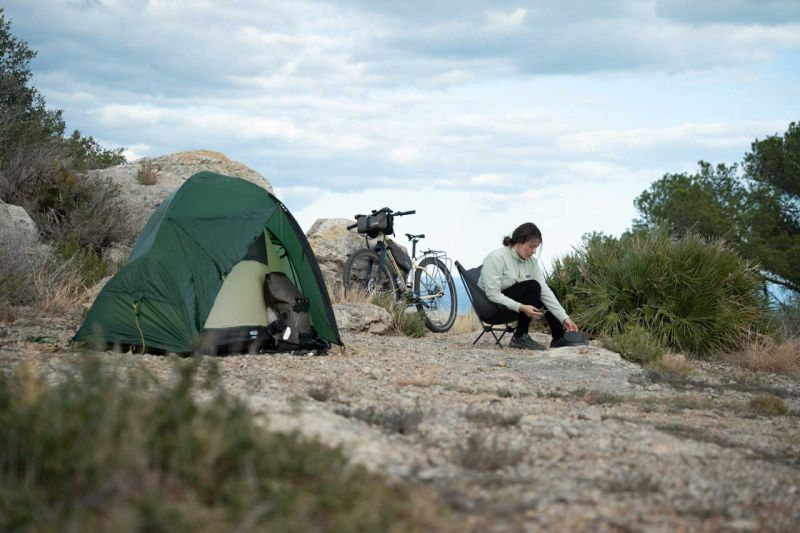
Bikepacking tents
11 tents for one and two people, 766 g to 1,884 g trail weight, with a shortenable stuff sack.
View tents →
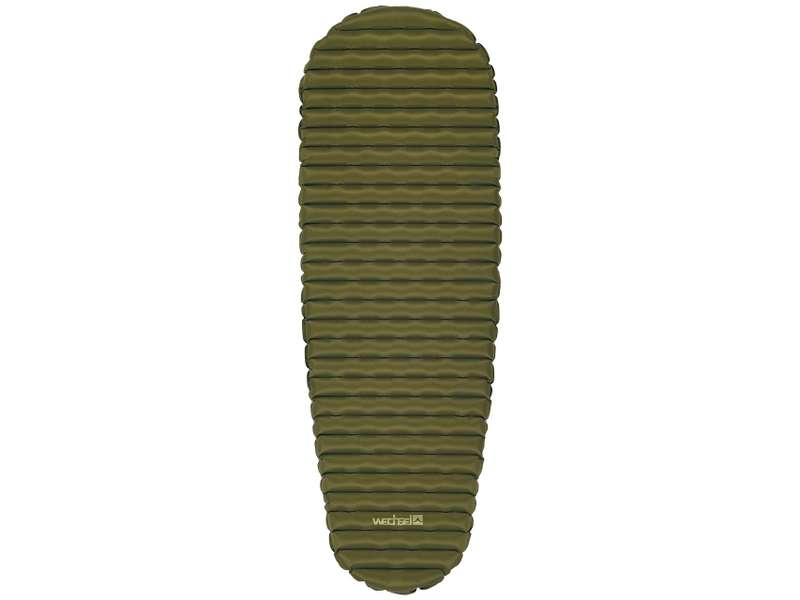
Ultralight sleeping mats
Aera M and L air mats with an R-value of 6, pack size from 20 x 12 cm.
View sleeping mats →
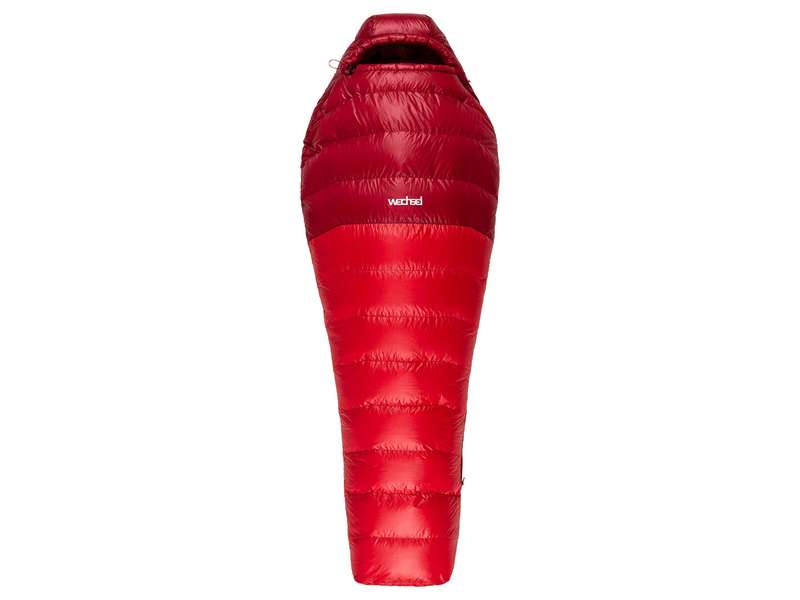
Bikepacking sleeping bags
Pyro 250, 500 and 750 down sleeping bags, compressed from 13 x 19 cm.
View sleeping bags →
Bikepacking kit list: what goes where
This is how to spread your sleep kit across the bike. Keep heavy items close to the frame so the bike stays steady.
| Bag | What goes in |
|---|---|
| Handlebar roll | Fly and inner in the shortened stuff sack, poles across if needed |
| Frame bag | Poles, tools, repair kit, water and food for the day |
| Saddle bag | Sleeping mat, sleeping bag, clothes for the evening |
| Top tube bag | Pegs, head torch, small items |
On gravel and rock, a matching groundsheet protects the tent floor. No tent is fully freestanding; to get the best from it, always use pegs. If a pole section breaks on tour, our spare parts service supplies single sections. Larger damage is handled by our repair service – in the UK by our partner Scottish Mountain Gear.